
Selling on Mercado Libre with a Hong Kong Company: How Global Selling Works
Selling on Mercado Libre with a Hong Kong Company: How Global Selling Works
Mercado Libre is the largest online marketplace in Latin America – a platform with more than twenty years of history and tens of millions of buyers across the region. For most of that history, selling on it meant being a local business. That has changed. The marketplace’s cross-border program, Global Selling, accepts sellers registered in exactly three places: the United States, mainland China, and Hong Kong. And the company is actively courting Asian sellers – it opened its first fulfillment centre inside mainland China in December 2025, and a senior Mercado Libre executive has publicly set a target of growing the China-based seller base tenfold within three years.
For a business owner sourcing from Chinese factories and looking at Latin America as a market, this raises a practical question: what does it take to get in, and how does the business run day to day? This guide walks through the full chain for a Hong Kong company – eligibility, registration, how the money flows, logistics, customs, taxes, and the categories to stay away from.
The short version
- Global Selling accepts a Hong Kong limited company on the same footing as a US or Chinese one. What the platform checks is where the company is registered – not the passport its owner holds.
- Registration and identity checks happen before any bank account is involved. The document pack Mercado Libre asks a Hong Kong seller for is the standard set produced when the company is incorporated.
- Buyers pay in their local currency. The seller is paid in USD, by international wire, roughly every two weeks.
- The buyer is the importer of record. Import taxes are calculated and shown at checkout – the seller prices them in but does not clear customs.
- Start with the ship-per-order model from China, and start with Mexico.
What Mercado Libre Global Selling is
Global Selling is Mercado Libre’s own cross-border program, built on the marketplace’s own logistics network (Mercado Envíos) and its own payment arm (Mercado Pago), with advertising available on the same account. It is a separate thing from Amazon’s similarly named program – the two are comparable only by analogy.
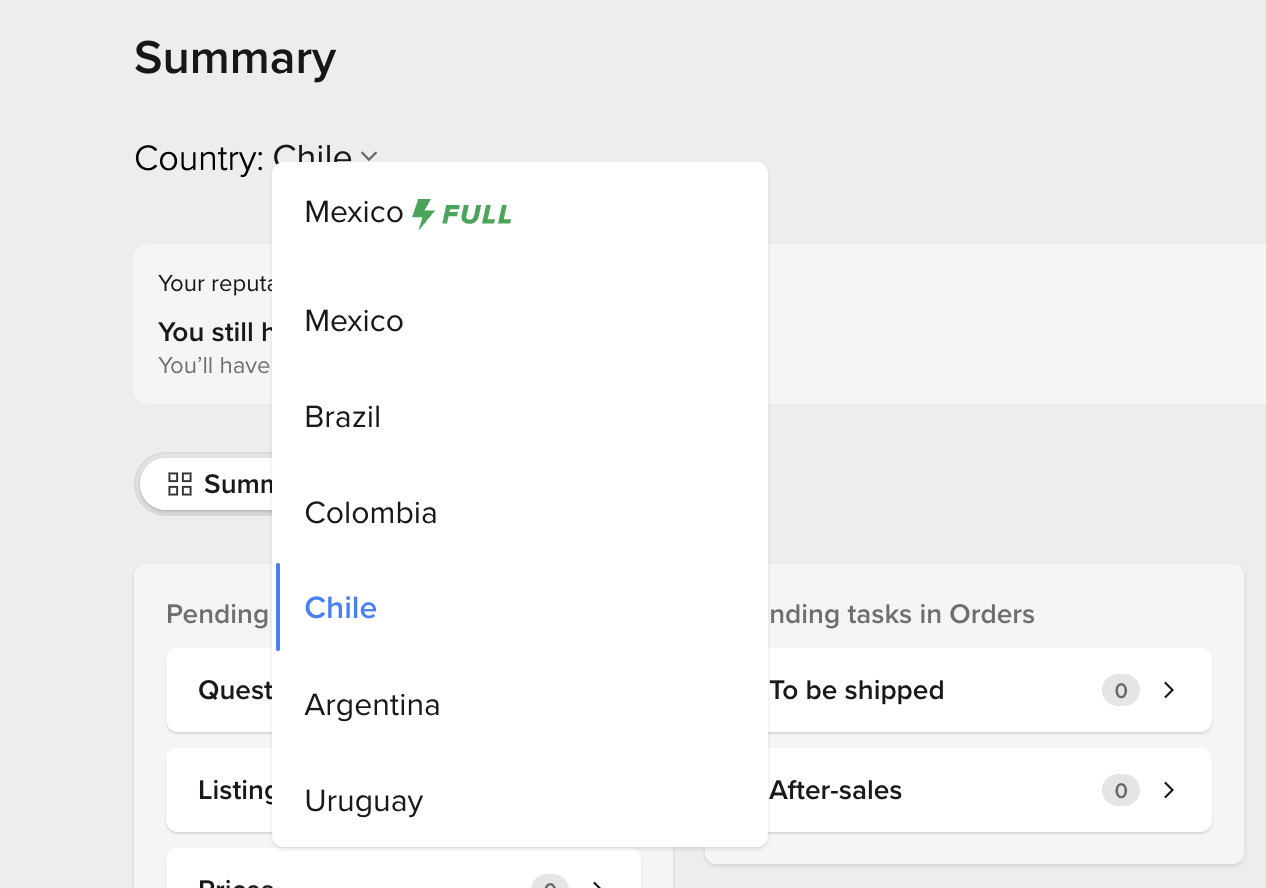
The mechanics are simple to describe. A seller from any of the three accepted origins creates one account, lists products once – in English, priced in USD – and pushes those listings to several Latin American marketplaces at the same time. The documented markets are Mexico, Brazil, Chile, Colombia, and Argentina (Argentina with limitations). USG’s own seller account also exposes Uruguay as a sixth market, which no public source documents yet – treat it as unproven, and note that Uruguay’s regime, which flipped on 1 May 2026, taxes China-origin parcels without an exemption, so it ranks below all five documented markets. Local currency, local payment methods, local delivery, and customs are handled inside the program.
What Global Selling costs: commissions and fees
There is currently no fee to join and no fee to list. The seller pays only when something sells. The charge is a commission on the sale price, plus a fixed per-unit fee on low-priced items, plus the cost of mandatory free shipping above each country’s price threshold. Optional advertising sits on top.
The commission is set by country, category and listing type – the cheaper Clásica listing against the more expensive Premium one, which adds buyer installments and visibility for roughly three to five points more. Across the five markets the bands run like this:
- 🇲🇽MexicoCommission about 12.5–22.5%
- 🇧🇷BrazilCommission about 11–20%
- 🇨🇱ChileCommission about 13–20%
- 🇨🇴ColombiaCommission about 9–22%
- 🇦🇷ArgentinaCommission about 12–17.5%
Treat those as directional. Pull the exact number for your own category from the fee simulator inside the account, because the bands move and the free-shipping thresholds move with them. The interest-free installments buyers see are bundled into that commission, so a cross-border seller pays no separate financing surcharge the way a local Latin American seller does.
Who can sell, and what the platform checks
The requirement is a registered limited company – individuals and sole traders are not accepted on this track.
Accepted company origins
The detail that matters for international founders: the test is the company’s country of registration. A founder from Turkey or Peru can own the Hong Kong company that sells on the platform. Marketplace eligibility is separate from bank compliance, and opening the company’s bank account has its own rules, but eligibility to sell is settled by the company.
Of the three eligible origins, Hong Kong is the practical choice for most non-US, non-Chinese owners:
- A US company typically drags the business into US tax filings and reporting – overhead that rarely makes sense for a founder with no other US connection.
- A mainland Chinese company requires real local substance, meaning an office and staff on the ground, which pure e-commerce does not need.
- A Hong Kong company is quick to register, inexpensive to maintain, banks in USD, and pays profits tax only on its net margin.
The program also works in the other direction. If you are based in Latin America and already sell in your home market, the program is a way to move part of an existing business onto international rails: the same Hong Kong company, the same USD payouts, with your home market as the first marketplace rather than the last – and Hong Kong’s profits tax runs lower than corporate rates in much of the region.
Registration and KYC: requirements and documents
Registration runs entirely online. After the account is created, Mercado Libre runs a mandatory verification of the legal entity – its KYC – and for a Hong Kong company the requested pack is short:
The KYC pack for a Hong Kong company
- 1Certificate of Incorporation – the company’s registration certificate.
- 2Incorporation form or annual return – the NNC1 for a young company, or the NAR1 after the first annual return.
- 3The legal director’s government ID – a passport works.
- 4A “proof of life” selfie by that same director.
- 5A signed shareholder attestation listing every beneficial owner holding 25% or more.
Files upload as PDF, JPG, or PNG, and the platform gives roughly 17 days to complete the check once it starts. A practical note: if the company has ever changed its name, upload the certificate chain that shows the current name – a certificate showing an old name tends to bounce.
No bank account is requested at any point during registration. The account is created and approved before any banking decision has to be made, and the payout account is attached later, when there is money to pay out. The document pack maps onto the standard set a Hong Kong company holds from day one of incorporation. The only extras are the signed attestation on the platform’s own template and the selfie.
USG has taken its own Hong Kong company through the full Global Selling registration, through to a validated account. The flow described here is what the platform put in front of us.
How payouts reach your company
The money chain is the best-documented part of the program, and it favours the seller on the point that matters most: the Hong Kong company never touches local currency.
- The buyer pays in their own currency, Mexican pesos or Brazilian reais, using local methods, including the cash and instant-payment rails popular in each market.
- Mercado Pago, the marketplace’s own payment arm, collects and holds the funds. The seller’s balance is denominated in USD.
- Mercado Libre deducts its commission and fees, converts at its own rate, and absorbs the exchange-rate movement between listing and settlement. The seller carries no peso or real exposure.
- The seller receives an international wire in USD on a two-week cycle, covering orders delivered at least two days before the payout run. Funds from open claims are held back until the claim resolves. Transfers below US$500 roll forward to the next cycle.
The receiving account must be a corporate USD account in the company’s name – a personal account is not accepted. A Hong Kong business bank account works, and so does the USD receiving account of a multi-currency payment institution; Mercado Libre also certifies several payment providers for the China–Hong Kong corridor. Which option fits best depends on volumes – at small scale a payment institution is usually enough, while at larger volumes a traditional bank account becomes worth the extra onboarding effort. Withdrawal fees and currency conversion on the seller’s side are charged by the receiving provider; the marketplace charges nothing extra for the payout itself.
How the goods move: two models
Global Selling gives a Hong Kong seller two ways to fulfil from China, and the right answer for a new account is the boring one.
Direct-to-Consumer – ship per order
Full China – stock the marketplace’s warehouse
Direct-to-Consumer – ship per order. A sale comes in, the seller prints the marketplace-generated label and delivers the parcel to a Mercado Libre consolidation warehouse in Shenzhen or Shanghai within about three business days. The platform consolidates parcels, flies them out, clears them, and delivers through its local network. Typical delivery time is around 15–25 working days. The appeal is the risk profile: no inventory pre-positioned, no capital tied up, five or ten units of a SKU are enough to start testing.
Full China – stock the marketplace’s warehouse. Since December 2025, sellers can drop inventory at Mercado Libre’s fulfillment centre in mainland China. From there the platform runs the entire chain – consolidation, the international leg, customs, sorting, last-mile. Delivery times fall dramatically, marketed as low as about five days on the best routes. The trade-off is committed inventory: this model makes sense once sales velocity is proven.
There is also a local-warehouse option in Mexico and Chile – stock held inside the destination country for one-to-two-day delivery – but it requires importing inventory at the seller’s own cost first, plus a local tax registration in Mexico and an invitation in Chile. It earns its place only at scale.
Customs: the buyer is the importer
On the standard cross-border flow, the buyer is the legal importer of record. Mercado Libre’s carrier acts as the customs declarant, and import taxes are estimated and collected at checkout as part of the total the buyer sees. The flow behaves like a delivered-duty-paid sale: the buyer sees product, shipping, and import costs itemised before paying, and the seller does not deal with customs paperwork at all.
The seller’s part is economic: import costs have to be priced into the listing. A price that looks competitive before border taxes can stop being competitive after them – which is why per-market pricing matters (more below), and why the platform’s bulk-clearance Full China model exists at all.
Because the buyer is the importer, a Hong Kong seller generally needs no local tax registration in Latin America to sell on the direct-shipping model. The exceptions are specific: holding local stock (Mexico requires a local tax number for that), and regulated product categories (below).
Taxes: the two layers to keep separate
Marketplace sellers routinely confuse two different tax layers. They are separate, paid by different parties, in different places.
Import & consumption taxes
Collected at checkout, per parcel. Volatile – verify current rates before pricing. Brazil: heavy above US$50, and the sub-US$50 relief is provisional. Chile: smallest tax hit. Mexico: payout withholding without a local tax number.
Profits tax on net margin
8.25% on the first HKD 2 million of profit, 16.5% above. No VAT and no tax on dividends. Costs of goods, logistics, commissions and advertising all deduct first.
Layer one – import and consumption taxes at the destination. These attach to each parcel and are collected from the buyer at checkout. They differ sharply by country and they have been changing constantly – nearly every Latin American import regime was rewritten between 2024 and 2026, so treat any specific rate as a snapshot to verify before pricing. Here is the current shape, country by country. Brazil taxes every parcel at the state level and taxes parcels above US$50 heavily, so as of August 2026 keeping items under the US$50 line is a real pricing strategy. That zero rating rests on a provisional measure Brazil’s Congress still has to confirm, and Brazil has rewritten this rule more than once already. Mexico has removed its low-value exemption for China-origin goods and applies flat courier-rate duties. Chile applies its 19% VAT from the first dollar but charges no duty on parcels under US$500, which currently makes it the friendliest border of the five. Colombia charges VAT on China-origin parcels regardless of value. Argentina layers its VAT on top of a duty-free allowance and remains the most restrictive market operationally.
Layer two – the Hong Kong company’s own profits tax. Hong Kong taxes the company’s net profit – revenue minus the cost of goods, logistics, marketplace commissions, advertising, and professional fees – at 8.25% on the first HKD 2 million and 16.5% above. There is no VAT or GST in Hong Kong, and no customs duty on ordinary goods. For a marketplace seller the practical advice is to keep the company onshore and simply pay the modest tax on the margin: marketplaces ask for tax certificates, and a company that files and pays reads as lower-risk to every bank and platform it touches.
The one-line summary: the taxes buyers see at checkout are Latin American border taxes, priced into the listing. What the Hong Kong company itself pays is a single-digit-to-mid-teens percentage of its net margin, and nothing else.
The five markets, and where to start
Sellers based in Latin America usually start with their home market – they know the demand and the price points. For everyone else, the usual order:
- 🇲🇽MexicoFastest cross-border growth, lightest friction, local-warehouse option at scaleStart here
- 🇧🇷BrazilThe biggest market of the five – price under the US$50 line while that relief lastsSecond
- 🇨🇱ChileSmallest friction at the border – the lightest import taxes of the five
- 🇨🇴ColombiaGrowing market with workable rules
- 🇦🇷ArgentinaSupported with limitations – treat it opportunistically
A few things the rows above do not carry. Without a Mexican tax number the platform withholds a slice of VAT and income tax from Mexican payouts, so either factor that into the margin or plan the registration. Colombia charges VAT on China-origin parcels at any value, not just above a threshold. And Argentina has historically been the most restrictive market operationally, which is why it sits at the end of the list.
What you cannot sell
Category rules end more cross-border plans than taxes do, so check them while you are still choosing the product.
Banned for everyone
Food, alcohol, medicines, tobacco, weapons, used goods – and loose lithium batteries and power banks. Built-in batteries under 100Wh are fine.
Closed to HK & China sellers
Perfumes and dietary supplements are limited to US-based sellers. A Hong Kong company cannot list them.
Listable but gated
Cosmetics and electronics are regulated at the destination. Expect to need a local importer or representative in each market – and in some, a product registration too.
- The banned list runs wider than the card: it also covers medical devices, vapes, jewelry and precious metals, adult products, and refurbished as well as used goods. Devices with built-in batteries under 100Wh, such as phones and cameras, go through a dedicated channel. Check the platform’s own restricted-category list against your product before committing.
- On the gated categories the requirement differs by country. Brazil wants a local health-agency registration for cosmetics and local certification for electronics, and the registration holder has to be a Brazilian entity. Mexico is lighter – a local importer and a responsible party on the label, rather than a product registration. Either way it means contracting a local importer or representative in each market: solvable, but a real cost line to price in before committing to the category.
For a first product, the safest ground is an ordinary consumer good that carries no battery and nothing a regulator treats as a health product.
The unit economics to run before you list
Sellers who make money on the program and sellers who quietly lose it tend to differ in a few habits.
Price per country, in USD. Each market carries its own commission level, shipping threshold, and border-tax burden, and the platform lets the seller set a separate USD price per marketplace. A single uniform price lands at wildly different final consumer prices across five borders – and lands worst in the biggest market. Run the landed-cost stack per country: commission, shipping, the fixed fee if the item is cheap, border taxes, and any payout withholding.
Budget for returns that never come back. A returned item almost always stays in the destination country – reverse freight to China usually costs more than the item is worth. Sellers register a local return address or, very often, simply refund and let the buyer keep the item. This is a normal cost line in cross-border marketplace economics. Money from a disputed order is held back from payouts until the case closes.
Protect the account’s reputation. Reputation is tracked per market and drives visibility and the ability to win the default-seller slot on a listing. Formal claims – “defective”, “not as described” – are what hurt; a quick refund settles most disputes before they register as claims. Cross-border sellers with slower delivery times compensate on the levers they do control: accurate listings and fast answers when a buyer asks something.
A launch plan that works
- Register or use a Hong Kong limited company. The incorporation documents are the marketplace’s KYC pack.
- Create the Global Selling account and pass verification, before any banking or stock decisions.
- Choose first products against the category rules above, and price them with the border taxes already in the number.
- Open with Direct-to-Consumer shipping into Mexico; add Brazil, pricing against its import-tax bands as they stand when you list.
- Attach the corporate USD payout account when the first payout approaches – bank or payment institution, in the company’s name.
- Watch the landed cost and the return rate in each market for a full cycle before scaling the winners into Full China fulfilment.
Common questions
Yes. Global Selling accepts sellers registered in the United States, mainland China, or Hong Kong. A Hong Kong limited company qualifies directly, whatever passport its owner holds.
No. Registration and the KYC check complete before any bank account is involved. The USD payout account is attached later, once there are sales to pay out.
In USD, by international wire, roughly every two weeks, for orders delivered at least two days before the payout run. Transfers below US$500 roll into the next cycle. The receiving account must be in the company’s name.
Not for the standard direct-shipping model – the buyer is the importer of record. A local tax number becomes relevant when you hold stock in-country (Mexico) or sell certification-gated categories. Without a Mexican tax number, expect withholding on Mexican payouts.
Both categories are listable but gated. In most markets cosmetics need a health registration held by a local entity; Mexico is lighter – a local importer and a responsible party on the label rather than a product registration. Either way, plan for a local partner. Electronics face local certification in Brazil and Mexico, and anything with a loose battery or power bank is prohibited outright. Perfumes and supplements are closed to Hong Kong and China-based sellers entirely.
Mexico – direct shipping plus a local-warehouse option, the fastest cross-border growth, and the lightest friction. Brazil is the biggest prize but needs pricing built around its import-tax bands, which move. Chile currently has the friendliest border taxes of the five.
The takeaway
Mercado Libre has opened a door that used to be closed: a marketplace of continental scale, reachable through a Hong Kong company that costs little to set up and runs on documents the company already holds. The program handles the hard infrastructure, from local payment methods through to customs clearance, and pays out in clean USD wires. What it does not do is run the business. Choosing products that clear the category rules, and pricing each market against its own border taxes, remain the seller’s job – and that is the work that decides whether the numbers come out.
Need help with this?
USG handles company formation, banking, accounting, and ongoing support in Hong Kong, China, and Singapore, including for sellers building exactly this setup. If Mercado Libre is on your list of markets and the entity question is still open, book a free half-hour call. The earlier in the process you ask, the more of it is still cheap to change.
Book a call with USG